
Loading...
Skip to main content

Built by operators

We built the tools we couldn’t buy.

Forty years between us across warehouse operations and software. Warehouse and operations work across the UK and the USA. One frustration: there are no visibility tools written for the mid-market 3PL that already runs a WMS. So we built them.

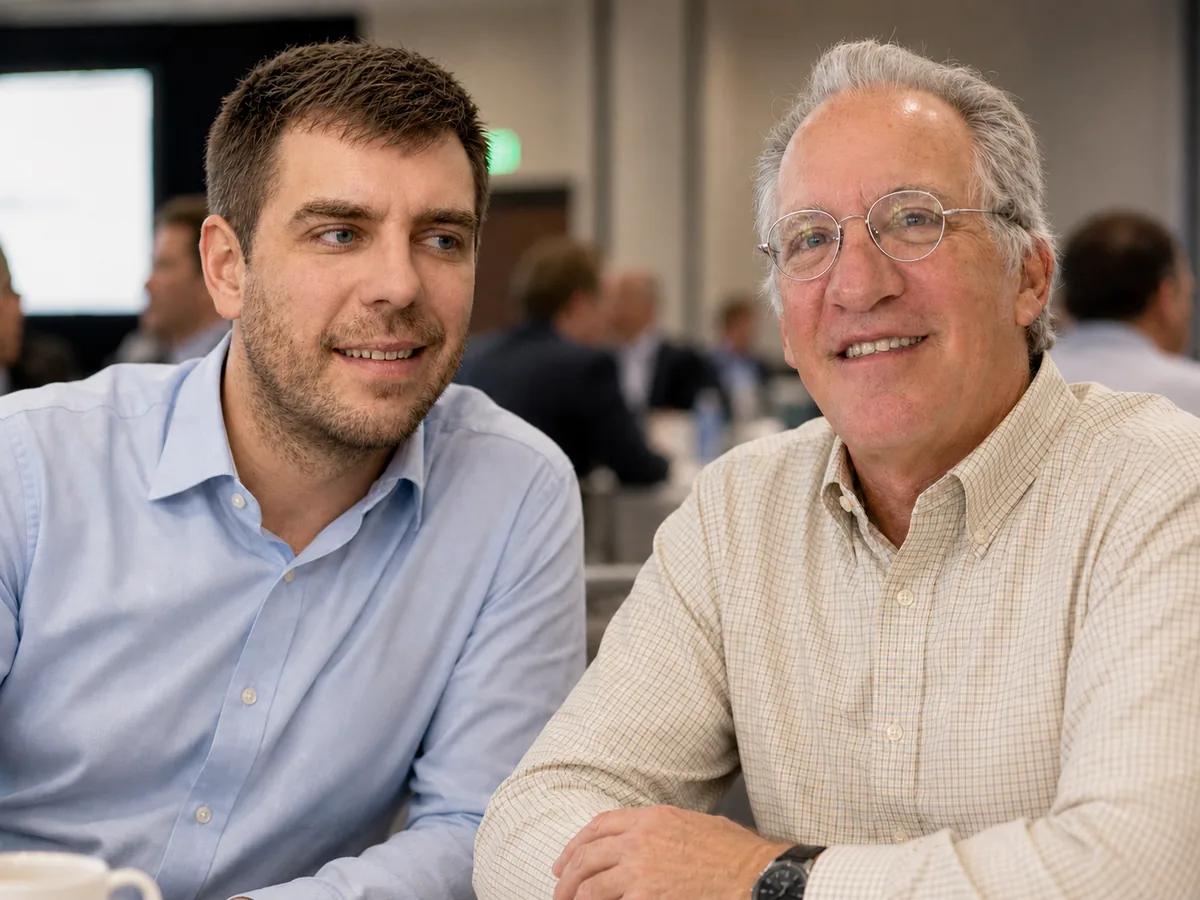
Chuck Feldman (Strategic Advisor, 3PL Operations) and Steven Sharp (founder, Warehouse Bridge)

Chuck Feldman — Strategic Advisor, 3PL Operations. Steven Sharp — founder.

How it started

Chuck and Steven met because they kept running into the same problem from opposite sides.

Chuck Feldman spent twenty years inside 3PL operations. He was VP of Logistics Applications and Systems at Port Logistics Group when Ryder acquired it. He’s been a CIO. He founded the NJCU Logistics Center. He has taught Management of Technology at NYU Tandon, where he also did his M.S.

Steven Sharp has twenty years of software development behind him. He runs and consults to B2B and B2C businesses that live on WMSes every day — he’s the half of the company that knows what an operations director needs from a piece of software, and what platform vendors keep refusing to ship.

They met because they kept running into the same problem from opposite sides.

Chuck’s frustration: “Every enterprise system I bought promised visibility. None of them delivered it. I’d spend six figures and eighteen months and at the end I still didn’t know which dock door was bleeding labour.”

Steven’s frustration: “I’d ship features that operators loved, watch them change how a warehouse ran — then watch the next client get sold a bloated platform that nobody used. The good tools were stuck inside bad packaging.”

So they built what they couldn’t buy.

What we build

A family of named visibility tools.

Warehouse Bridge is a family of named visibility tools for 3PLs that already have a WMS. Each tool fixes one specific visibility gap. You buy what you need.

  • DockSnap — photo evidence at the dock. Tagged to the BOL, the POD, the shipment ID. (docksnap.io)
  • Warehouse Heatmap — pick history on top of your slotting. Hot zones, dead zones, ranked re-slot moves. (3plheatmap.com)
  • Client Scorecard — per-client portal with per-client login. The QBR pack builds itself. (3plscorecard.com)
  • Hardware — pick-to-light, put walls, put-away. Banner Engineering OEM components, our controller, your install. (hardware)

Four tools. Three software, one hardware. Each works on its own. Together they form what we call The 3PL Operating System — a method, not a monolith.

Why named tools

Don’t sell people platforms. Build them tools they reach for.

We do not build platforms. Platforms are graveyards for features nobody asked for. We build named, single-purpose tools, each one solving one specific visibility problem.

Because operators have been burned by platforms. Eighteen-month implementations. Six-figure consultants. Dashboards nobody opens. Mid-market 3PLs deserve better.

Named tools are honest. You know what you’re buying. You can use one without the others. You can cancel one without losing the rest. You can teach a forklift driver what DockSnap does in a sentence — you can’t do that with “the platform.”

This is the heart of how we work.

The method

The 3PL Operating System

Most warehouse failures aren’t WMS failures. They’re visibility failures. You can’t fix what you can’t see. We organise everything we build around the 3PL Operating System — five steps that move an operator from blind to oversubscribed.

  1. 01 See it DockSnap
  2. 02 Map it Warehouse Heatmap
  3. 03 Score it Client Scorecard
  4. 04 Light it Hardware
  5. 05 Oversubscribe The whole stack
Read the methodology

What we won’t do

The discipline of saying no is half the strategy.

  • We won’t be a WMS. Your Camelot does receiving, picking, shipping. We don’t compete with it. We sit on top of it.
  • We won’t sell vapour-platforms. Every product has its own name, its own domain, its own price. If a product can’t stand on its own two feet, we don’t ship it.
  • We won’t gate pricing. Each product’s price is on its own site. No “contact sales.”
  • We won’t lock you in. Modular by design. Cancel a tool, keep the others. Take your data with you.
  • We won’t put engineers on your floor. Everything we ship is DIY-installable. You know your warehouse better than any consultant we could send.

The five promises

What you get from us, every time.

01

DIY install.

If you can hang a shelf, you can install our hardware. If you can use email, you can configure our software.

02

Industrial-grade or nothing.

Banner Engineering components. IP67-rated. Real warehouse temperatures and dust.

03

Honest pricing.

It’s on the page. Mid-market means transparent.

04

Modular.

Buy one tool. Add another when it earns its place.

05

Fast results.

Most customers we’ve worked with report a measurable win in the first 14 days.

The proof

We don’t just write SaaS. We ship hardware.

We have to put physical things in real boxes that survive UPS, get unpacked by warehouse staff, and bolt to a rack without an engineer. That’s a discipline most software companies have lost. We keep it because warehouses demand it.

The team, in detail

Forty years between us. One founder, one advisor.

Chuck Feldman, Strategic Advisor (3PL Operations) — Warehouse Bridge

Chuck Feldman

Operator. Educator. Builder.

Strategic Advisor, 3PL Operations

Chuck is the operations voice behind Warehouse Bridge. Over twenty years on warehouse floors — as a CIO, as VP of Logistics Applications and Systems at Port Logistics Group (acquired by Ryder), and as the founder of the NJCU Logistics Center, which trains the next generation of supply-chain professionals out of New Jersey City University. He holds an M.S. in Management of Technology from NYU Tandon and serves as Executive-in-Residence at the Ricciardi School of Business. Chuck has lived every failure mode of enterprise warehouse software, and serves as Strategic Advisor (3PL Operations) to make sure mid-market 3PLs get the visibility tools the enterprise vendors won’t build for them.

  • 20+ years in 3PL operations leadership
  • Former VP, Logistics Applications & Systems — Port Logistics Group (acquired by Ryder)
  • Founder, NJCU Logistics Center
  • Executive-in-Residence and Faculty Instructor, Ricciardi School of Business
  • M.S. Management of Technology, NYU Tandon School of Engineering

Steven Sharp, founder — Warehouse Bridge

Steven Sharp

Twenty years shipping production code into operations.

Founder, Technology

Steven founded Warehouse Bridge and runs the engineering. He has twenty years of software development behind him, running and consulting to B2B and B2C businesses that live on WMSes every day. He’s seen what platform vendors ship to operators, and watched too many of those “platforms” collapse under their own weight. Steven is the reason Warehouse Bridge is modular instead of monolithic. He started the company to build the tools he kept seeing operators ask for and vendors refuse to ship.

  • 20 years of software development (B2B and B2C)
  • Runs and consults to companies that use WMSes every day
  • Camelot integration shipping today; other WMS on the roadmap
  • Modular-not-monolithic on platform-vs-tool architecture
  • Founder, Warehouse Bridge

Not sure where you’d start?

Take the 3PL Operating Scorecard — sixty seconds, eight questions. You’ll get back the named tool that fits your weakest link, plus a one-page report you can keep.

Top