Part of Warehouse Visibility Series
Using heat maps to reduce warehouse travel time
Warehouses that outperform their peers do not move faster — they move less. The 55/55 math behind why travel time is the single biggest controllable cost inside the operation, and three strategic levers for reducing it.
Warehouses that outperform their peers do not move faster — they move less.
Reducing travel time in a warehouse is one of the fastest ways to improve productivity and lower labour costs. By placing high-activity items closer to pick, pack, receiving, and shipping areas, companies move product faster and reduce wasted steps.
Reducing order-picking costs by eliminating travel
Order picking is the single largest cost driver in warehouse operations, accounting for approximately 55% of total operating costs in most distribution and 3PL environments. Any meaningful improvement in warehouse efficiency must begin here.
A closer look at order picking reveals a critical insight:
- 55% — Travelling to pick locations
- 15% — Searching for items
- 10% — Extracting product
- 20% — Paperwork and other activities
The majority of picking costs are not picking — it is movement. Every unnecessary step is paid for in labour, time, and lost capacity.
The core problem: travel time
Travel time represents the highest controllable cost inside the warehouse. Unlike labour rates or facility leases, travel inefficiency is largely driven by internal decisions: layout design, slotting logic, and picking processes.
Reducing travel time delivers immediate, compounding benefits:
- Lower labour cost per order
- Increased throughput without additional headcount
- Improved service levels and consistency
- Faster scalability during peak demand
Three strategic levers to reduce travel
1. Warehouse layout
Layout determines how far work must move before value is created.
Key actions:
- Slot high-velocity SKUs near packing and shipping
- Design pick zones to limit cross-warehouse travel
- Align storage strategies with pick frequency, not just cube utilisation
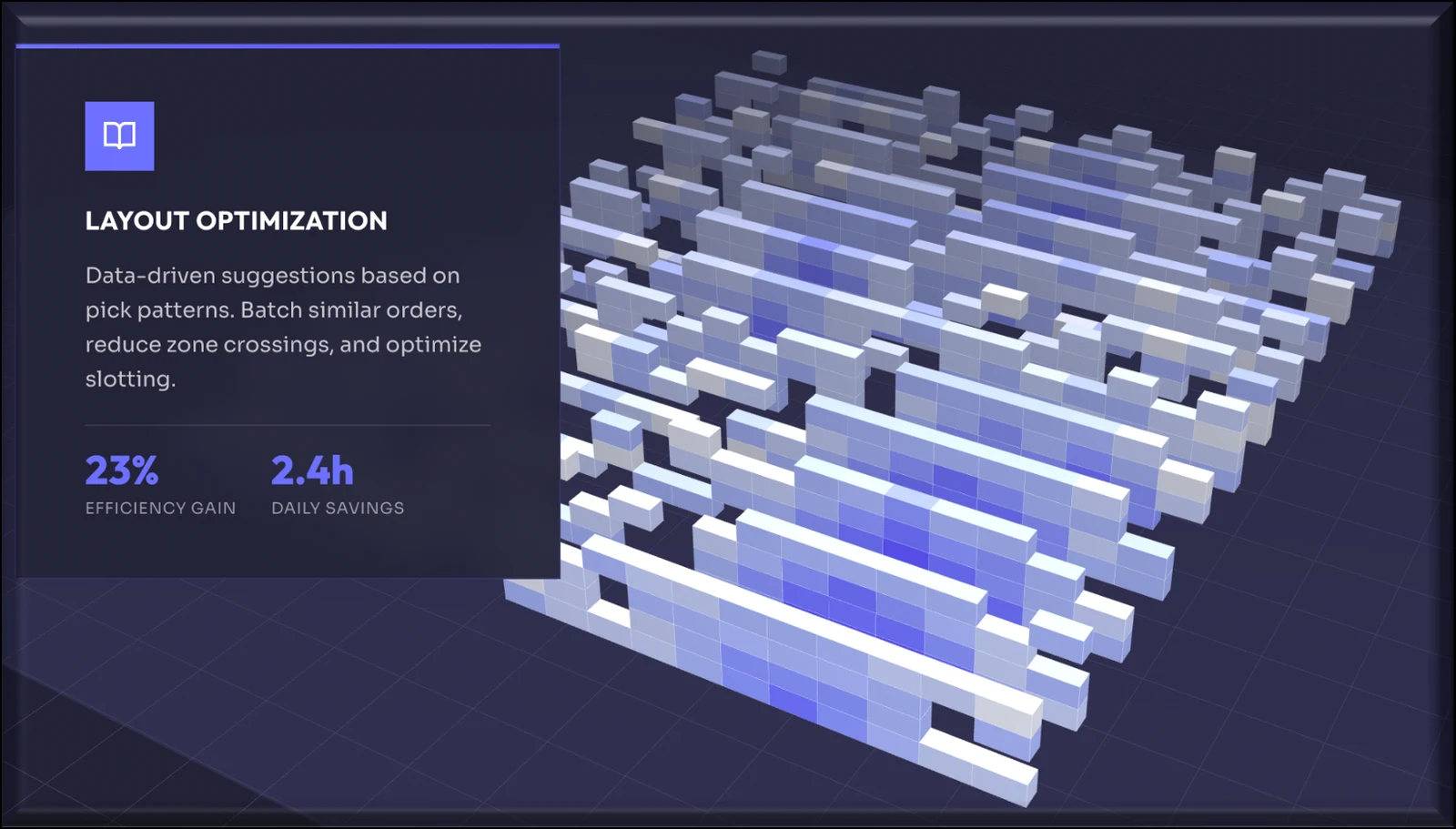
A warehouse optimised for storage efficiency is rarely optimised for labour efficiency. This is what Warehouse Heatmap is built to surface — months of WMS pick history rendered as a single picture of your floor, with hot zones red and dead zones grey.
2. Picking process
Process design determines how often travel is repeated.
High-impact improvements include:
- Batch, wave, or zone picking to consolidate movement
- Optimised pick paths to eliminate backtracking
- Task interleaving to reduce non-productive travel
Process discipline turns layout improvements into sustained results.
3. Automation
Automation creates the greatest return when it removes travel, not just speeds up individual picks.
Effective applications include:
- Pick-to-light
- Smart glasses
- Put walls and put-away light walls
Automation should be justified by steps eliminated and labour-hours avoided. Warehouse Bridge hardware is built around exactly this principle — industrial-grade pick-to-light, put walls, and put-away systems shipped DIY-installable on an industrial OEM controller. That is Step 4 of the 3PL Operating System — Light It.
Executive takeaway
If order picking represents over half of warehouse operating costs, and travel represents over half of picking time, the conclusion is clear:
The fastest path to lower costs and higher capacity is reducing travel.
Warehouses that outperform their peers do not move faster — they move less.
If you are not sure which lever to pull first, the 3PL Operating Scorecard takes sixty seconds and tells you which dimension of your operation is bleeding worst right now. Eight questions. One named tool to start with.
— Chuck & Steven
Want to know which step matters most for you?
Take the 3PL Operating Scorecard. Eight questions, sixty seconds. We’ll show you which dimension is bleeding worst and which named tool to start with.